
Best IPTV for Electronics Enthusiasts: How to Stream 4K Live Sports in Brasil Without Buffering
If you have ever spent a small fortune building the perfect home entertainment setup — a 65-inch OLED, a Dolby Atmos soundbar, a Wi-Fi 6 router, maybe an NVIDIA Shield tucked behind the TV — you already know the dirty secret of the electronics world: the hardware is rarely the problem. The content delivery is. A gorgeous 4K panel is wasted on a compressed satellite feed that pixelates every time a striker runs at full speed. That is exactly where IPTV changes the game, and why so many electronics lovers in Brasil are quietly ditching their cable boxes for a smarter, faster, sports-first streaming stack.
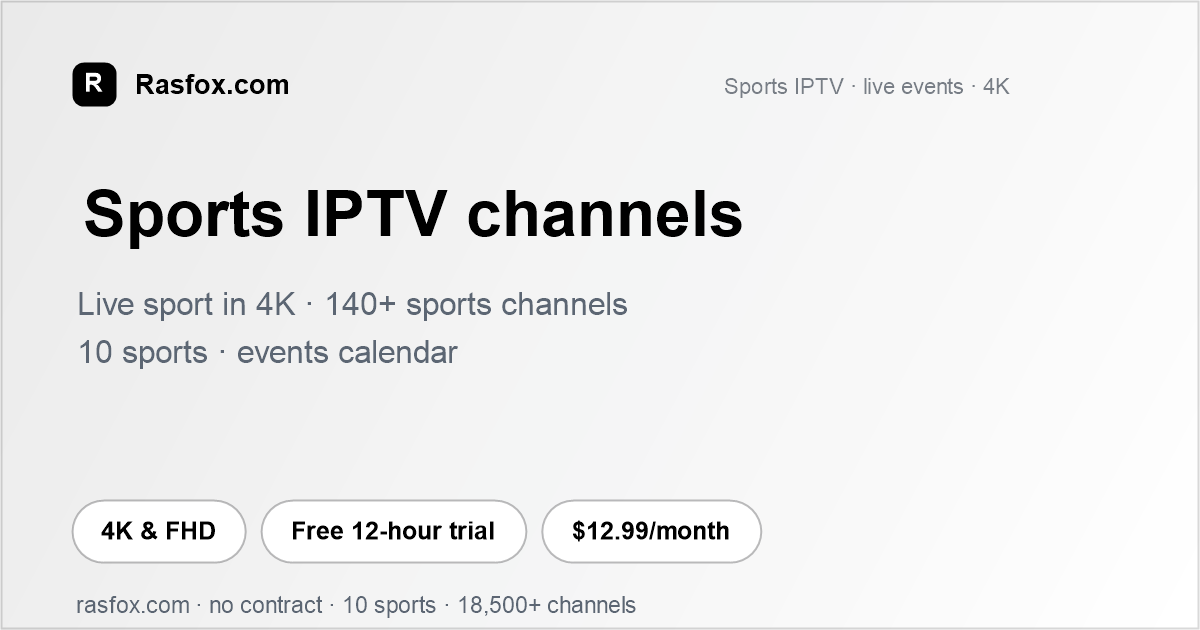
In this guide, we will look at IPTV the way an electronics enthusiast actually should: through the lens of bitrate, codecs, hardware compatibility, and real-world performance. We will also explain why the smart money in Brasil is moving toward sports-focused providers like RasFox — and how to avoid the buffering traps, shady resellers, and dead-end apps that give IPTV a bad name.
What Is IPTV and How Does It Transform Live Sports on Your Electronics?
IPTV stands for Internet Protocol Television. Instead of receiving channels through a coaxial cable, a satellite dish, or a terrestrial antenna, IPTV delivers live TV and on-demand content as data packets over your existing internet connection. If you can stream a YouTube video in 4K, you already have the technical foundation for IPTV.
For electronics enthusiasts, the appeal is not just convenience — it is control. With a traditional cable package, you accept whatever resolution, frame rate, and channel lineup the operator gives you. With IPTV, you choose the device, the app, the interface, and often the exact quality tier that matches your bandwidth and screen.
Why Frame Rate Matters More Than Resolution
Here is something most cable marketing teams will never tell you: a 1080p stream at 50 or 60 frames per second usually looks dramatically better for live sports than a 4K stream at 25fps. Football, MMA, and Formula 1 all involve rapid horizontal motion. Low frame rates produce judder, motion blur, and that smeary "ghosting" effect around fast-moving objects.
That is why RasFox IPTV has built its entire infrastructure around 4K at 50 FPS — a combination that turns a good panel into a genuinely cinematic sports experience. No stutter, no blur, no artifacts crawling across the grass during a counter-attack.
What RasFox Actually Delivers
- 12,000+ live channels spanning sport, news, entertainment, kids, and documentaries
- 40,000+ VOD titles including films, series, and full match replays
- 4K at 50 FPS on supported sports feeds
- 2 simultaneous screens on the same subscription — ideal for a multi-room setup
- No contract, no lock-in — cancel whenever you want
- 24-hour free trial so you can stress-test it on your own hardware
- Support in Portuguese and Spanish for lusophone and latino customers
The absence of buffering is not marketing fluff. It comes down to server load balancing and peering — the parts of the chain that cheap resellers cut corners on. A provider with overloaded servers will fail you at exactly the moment it matters most: the 89th minute of a derby.
Your Electronics Deserve Better Content: How IPTV Completes a Modern Setup
Think of your home theatre the way a system builder thinks about a PC. A powerful GPU is useless without fast storage. A great TV is similarly throttled by a weak source. IPTV is the "fast storage" of the television world — it removes the bottleneck between what your display can do and what it is actually being fed.
This is where the electronics side of the equation becomes genuinely interesting:
- Smart TVs from Samsung, LG, TCL, Philips, and Hisense all handle IPTV natively through dedicated apps — no extra hardware required.
- Android TV and Google TV devices offer the widest app compatibility and the best EPG (electronic program guide) experience.
- Streaming sticks like the Fire TV Stick 4K Max turn a ten-year-old television into a fully modern IPTV terminal for the price of a dinner out.
- Set-top boxes such as the NVIDIA Shield Pro remain the gold standard for anyone who refuses to compromise on decoding performance.
- Projectors benefit enormously, because IPTV scales cleanly and lets you push a 120-inch image without a satellite dish bolted to your roof.
The practical takeaway: you almost certainly already own the hardware you need. If you want a provider that supports all of these devices out of the box with a clean setup process, the best IPTV service for multi-device homes is worth testing before you buy anything new.
Deep Dive: The IPTV Landscape in Brasil
Brasil is one of the most interesting IPTV markets on the planet right now, and the reasons are largely structural.
Why Brasil Is an IPTV Hotspot
Over the past decade, Brazilian fibre-to-the-home coverage has expanded aggressively. Millions of households now have symmetrical connections of 300 Mbps or more, and 5G mobile coverage keeps widening in the major metropolitan regions. Meanwhile, satellite and cable subscription prices have climbed steadily, while the content on those packages has fragmented across more and more premium tiers.
The result is a market where the infrastructure is ready but the traditional distribution model is not keeping up. Brazilian viewers are not short on bandwidth — they are short on flexible, well-priced access to the matches they actually want to watch.
The Sports Channels That Actually Matter
For a Brazilian sports fan, a provider is only as good as its coverage of the following:
- Globo — the free-to-air giant that still carries the biggest matches
- SporTV — the workhorse of Brazilian cable sport
- Premiere — the dedicated Brasileirão pay-per-view engine
- ESPN Brasil — international football, NBA, and analysis
- BandSports — motorsport, volleyball, and niche coverage
- Combate — the home of UFC and Brazilian jiu-jitsu culture
- TNT Sports Brasil — Champions League nights
Beyond domestic channels, a complete IPTV package should also open the door to TyC Sports, ESPN Premium, Fox Sports, and DirecTV Sports for South American coverage, Sport TV and Eleven Sports for Portuguese football, and the global heavyweights: ESPN, DAZN, beIN Sports, Sky Sports, and Eurosport.
As for competitions, the list that matters most to Brazilian viewers is predictable but non-negotiable: Brasileirão, Libertadores, Champions League, Premier League, La Liga, Liga Portugal, Liga Argentina, Formula 1, and UFC. If a provider cannot deliver all of those in stable HD or 4K, it is not a serious sports service.
The Radio Malena Heritage: Tango, Tradition, and a Sports-First Philosophy
There is a story behind RasFox that most streaming services simply cannot tell. Its roots trace back to Radio Malena 89.1 FM in Buenos Aires, Venezuela 370 — a station steeped in the tango and Argentine cultural tradition that has connected listeners across generations.
That broadcast DNA shapes everything about how the platform is built today. Radio taught the team something that pure tech companies often miss: people do not subscribe to technology, they subscribe to moments. The final whistle. The penalty shootout. The last lap. The knockout punch.
So when Radio Malena's team moved into IPTV, they did it with a deliberate, unmistakable bias: sport comes first. Not as an afterthought buried in a bloated channel list, but as the core of the offering for lusophone and latino communities around the world — in Brasil, Portugal, Argentina, Venezuela, Angola, Moçambique, and far beyond.
Hardware and Setup Guide for Electronics Enthusiasts
Setting up IPTV properly is a fifteen-minute job if you approach it like a system configuration rather than a guessing game. Here is the practical breakdown.
Step 1: Match the Device to Your Needs
- Casual viewer, modern smart TV: install the recommended app directly, no extra hardware.
- Older TV, small budget: a Fire TV Stick 4K Max or a mid-range Android TV box.
- Enthusiast, demanding user: NVIDIA Shield Pro or a premium Android box with hardware H.265 decoding.
- Multi-room setup: a subscription with two simultaneous connections, running on two separate devices.
Step 2: Get Your Bandwidth Right
As a rule of thumb:
- 10–15 Mbps for stable Full HD
- 25 Mbps for comfortable 4K
- 50 Mbps+ if multiple people stream at once
Two upgrades eliminate the vast majority of "IPTV buffering" complaints, and neither involves changing your provider:
- Use Ethernet instead of Wi-Fi for your main box or TV. It removes an entire category of interference problems.
- Enable QoS on your router so your streaming device gets priority over background downloads and IoT traffic.
Step 3: Test Before You Commit
Never buy an annual plan blind. A serious provider will let you evaluate the service on your own hardware, on your own network, during a live match. That is precisely why RasFox offers a 24-hour free IPTV trial — you can verify the frame rate, the EPG quality, the channel switching speed, and the stability under real conditions before spending anything.
Step 4: Optimise the Interface
- Build a favourites list of your must-watch sports channels so you never scroll during kickoff.
- Load a proper EPG so you can see what is live now and record the rest.
- Group channels by league or sport if your app supports custom categories.
- Keep a backup device configured — a stick or box already logged in — for matchday insurance.
Legal vs Illegal IPTV: Safety and Best Practices
This is the section most articles gloss over, and it is the one that matters most for your security.
"IPTV" itself is a completely legitimate technology. Broadcasters, telecom operators, and major media groups all use IPTV infrastructure. The problem is that the term has been hijacked by a grey market of resellers offering unlicensed streams at implausibly low prices.
How to Tell the Difference
- Legitimate, licensed services are transparent about their company, offer real customer support, publish terms of service, and do not promise literally every premium channel on earth for the price of a coffee.
- Unauthorised operations frequently vanish overnight, take payment through untraceable channels, provide no support, and — critically — often bundle their apps with adware or credential-stealing code.
The real-world risks are not abstract. In Brasil, Anatel has been actively blocking unauthorised streaming operations, which means customers of shady providers regularly wake up to a dead service mid-season. Beyond the financial loss, there is a genuine cybersecurity dimension: sideloaded apps from unverified sources are one of the most common infection vectors for smart TVs and streaming boxes.
What a Safe Provider Looks Like
- A real free trial so you can verify quality before paying
- No long-term contract — month-to-month or short-term plans
- Responsive customer support in Portuguese and Spanish
- Realistic claims about channel counts and performance
- Clear device compatibility documentation
For readers who want a setup that ticks all of those boxes, the best IPTV service for sports fans in Brasil is a sensible starting point. It offers a no-contract structure, a 24-hour trial, dual-screen support, and — crucially — a sports-first channel architecture built by people who have spent their careers broadcasting live events.
Final Thoughts: Build the Setup, Then Feed It Properly
Electronics enthusiasts spend enormous energy optimising hardware: the panel, the soundstage, the seating distance, the ambient lighting. But a system is only as strong as its weakest link, and for most home theatres, that link is content delivery.
IPTV closes the gap. It gives your 4K display a 4K 50 FPS source. It gives your multi-room setup a two-screen subscription. It gives you Brasileirão, Libertadores, Champions League, Formula 1, and UFC without a satellite dish, a twelve-month contract, or a technician appointment.
And when it is built by a team with roots in Argentine radio culture — Radio Malena 89.1 FM, Venezuela 370, Buenos Aires — you are not just buying bandwidth. You are buying a service designed around the moments that make sport worth watching in the first place.
Ready to test it on your own hardware? Start with the RasFox IPTV 24-hour free trial, plug in your device, load a live match, and judge it with your own eyes.
Frequently Asked Questions
1. What internet speed do I need for IPTV in 4K?
For a single 4K stream you should aim for at least 25 Mbps of stable, consistent bandwidth. Multiple simultaneous streams will require 50 Mbps or more. Wired Ethernet is strongly recommended over Wi-Fi for the primary viewing device.
2. Can I watch Brasileirão, Libertadores, and the Champions League on IPTV?
Yes — a sports-focused IPTV provider covers Brasileirão, Libertadores, Champions League, Premier League, La Liga, Liga Argentina, Formula 1, and UFC. RasFox carries Brazilian channels such as Globo, SporTV, Premiere, ESPN Brasil, BandSports, Combate, and TNT Sports BR.
3. Is IPTV legal in Brasil?
IPTV technology itself is completely legal. What is illegal is redistributing copyrighted broadcasts without a licence. That is why choosing a transparent provider with real support, clear terms, and no suspiciously unlimited pricing is essential.
4. How many devices can I use at the same time?
RasFox supports two simultaneous screens per subscription, which covers the typical household: one for the living room and one for the bedroom, or one for football and one for everything else.
5. Is there a free trial before I subscribe?
Yes. RasFox offers a 24-hour free trial with no contract and no long-term commitment, so you can test channel stability, 4K 50 FPS quality, and device compatibility on your own network before paying.